

Get hydrophobicity#
Evaluating amino acid hydrophobicity scores from standard biochemical scales.
The function molsysmt.physchem.get_hydrophobicity() assigns hydrophobicity indices per residue using 15 published experimental and statistical scales:
'eisenberg': Consensus normalized scale from Eisenberg et al. (1984).'kyte': Hydropathy index from Kyte & Doolittle (1982).'chothia': Transfer free energy scale from Chothia (1976).'black': Hydrophobicity scale from Black & Mould (1991).'wolfenden': Free energy of vapor-to-water transfer from Wolfenden et al. (1979).'rao': Rao & Argos (1986).'sweet': Sweet & Eisenberg (1983).'abraham': Abraham & Leo (1987).'bull': Bull & Breese (1974).'guy': Guy (1985).'miyazawa': Miyazawa & Jernigan (1985).'roseman': Roseman (1988).'hopp': Hopp & Woods (1981).'manavalan': Manavalan & Ponnuswamy (1978).'fauchere': Fauchère & Pliška (1983).
Added in version 1.0.0.
API documentation
Follow this link for a detailed description of the input arguments, raised errors, and returned objects of this function: molsysmt.physchem.get_hydrophobicity().
Basic usage#
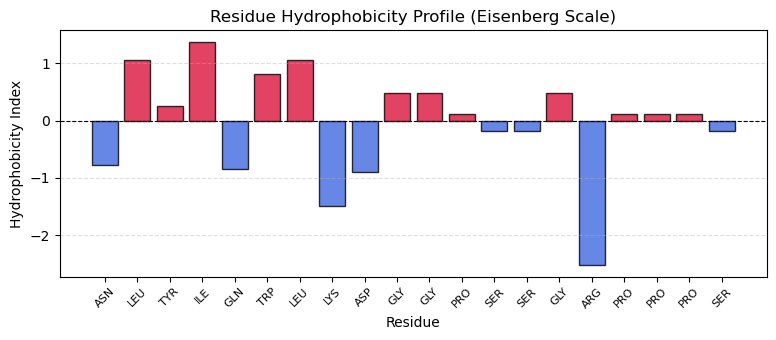
By default (definition='eisenberg'), the consensus hydrophobicity values are returned for each residue:
import molsysmt as msm
import matplotlib.pyplot as plt
molsys = msm.convert(msm.systems['Trp-Cage']['1l2y.h5msm'])
Note
Demo Systems Catalog
This tutorial uses demonstration datasets provided by MolSysMT. To explore the full catalog of bundled systems, forms, and file paths, visit the Demo Systems guide.
We query the Eisenberg hydrophobicity scores and plot the sequence profile:
hp = msm.physchem.get_hydrophobicity(molsys, element='group', definition='eisenberg')
group_names = msm.get(molsys, element='group', name=True)

fig, ax = plt.subplots(figsize=(8, 3.5))
colors = ['crimson' if val > 0 else 'royalblue' for val in hp]
ax.bar(range(len(hp)), hp, color=colors, edgecolor='black', alpha=0.8)
ax.axhline(0, color='black', linestyle='--', linewidth=0.8)
ax.set_xticks(range(len(hp)))
ax.set_xticklabels(group_names, rotation=45, fontsize=8)
ax.set_title('Residue Hydrophobicity Profile (Eisenberg Scale)')
ax.set_xlabel('Residue')
ax.set_ylabel('Hydrophobicity Index')
ax.grid(True, linestyle='--', alpha=0.4, axis='y')
plt.tight_layout()
plt.show()
Alternative hydrophobicity scales#
Users can choose other established scales depending on the physical context (e.g. definition='kyte', definition='chothia', definition='black', definition='wolfenden'):
hp_kyte = msm.physchem.get_hydrophobicity(molsys, element='group', definition='kyte')
hp_chothia = msm.physchem.get_hydrophobicity(molsys, element='group', definition='chothia')
hp_black = msm.physchem.get_hydrophobicity(molsys, element='group', definition='black')
hp_wolfenden = msm.physchem.get_hydrophobicity(molsys, element='group', definition='wolfenden')

print('Kyte & Doolittle (first 5):', hp_kyte[:5])
print('Chothia scale (first 5):', hp_chothia[:5])
print('Black scale (first 5):', hp_black[:5])
print('Wolfenden scale (first 5):', hp_wolfenden[:5])
Kyte & Doolittle (first 5): [-3.5  3.8 -1.3  4.5 -3.5]
Chothia scale (first 5): [0.12 0.45 0.15 0.6  0.07]
Black scale (first 5): [0.236 0.943 0.88  0.943 0.251]
Wolfenden scale (first 5): [-9.68  2.28 -6.11  2.15 -9.38]
See also
Related Tools & References
Convert: Convert molecular systems with
molsysmt.basic.convert().Get: Query residue names and attributes with
molsysmt.basic.get().Get polarity: Query residue polarities with
molsysmt.physchem.get_polarity().Get transmembrane tendency: Query transmembrane propensities with
molsysmt.physchem.get_transmembrane_tendency().