

Get contacts#
Computing contact maps and inter-atomic contact matrices.
The function molsysmt.structure.get_contacts() calculates a boolean contact matrix or a list of interacting atom/centroid pairs where the Euclidean distance is below a specified cutoff threshold.
Added in version 1.0.0.
API documentation
Follow this link for a detailed description of the input arguments, raised errors, and returned objects of this function: molsysmt.structure.get_contacts().
Basic usage#
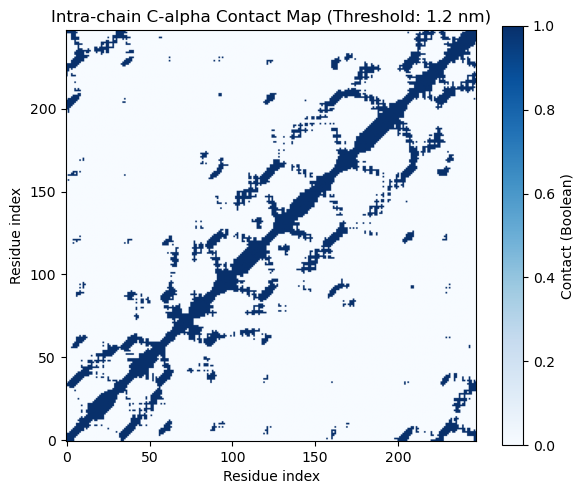
Let’s compute and plot the intra-chain C-alpha contact map of TcTIM (PDB ID: 1TCD):
import molsysmt as msm
import numpy as np
import matplotlib.pyplot as plt
molsys = msm.convert(msm.systems['TcTIM']['1tcd.h5msm'])
Note
Demo Systems Catalog
This tutorial uses demonstration datasets provided by MolSysMT. To explore the full catalog of bundled systems, forms, and file paths, visit the Demo Systems guide.
We select all C-alpha atoms in the first chain and compute contacts using a threshold of 1.2 nm:
ca_atoms_A = msm.select(molsys, selection='chain_id=="A" and atom_name=="CA"')
contact_map_A = msm.structure.get_contacts(molsys, selection=ca_atoms_A, threshold='1.2 nm')
print('Contact map shape:', contact_map_A.shape)
print(f'Total contacts: {np.sum(contact_map_A)}')
Contact map shape: (1, 248, 248)
Total contacts: 7764
We display the 2D boolean contact matrix using Matplotlib:
fig, ax = plt.subplots(figsize=(6, 5))
im = ax.imshow(contact_map_A[0], cmap='Blues', origin='lower')
ax.set_title('Intra-chain C-alpha Contact Map (Threshold: 1.2 nm)')
ax.set_xlabel('Residue index')
ax.set_ylabel('Residue index')
plt.colorbar(im, ax=ax, label='Contact (Boolean)')
plt.tight_layout()
plt.show()
Computing contacts between two different atom selections#
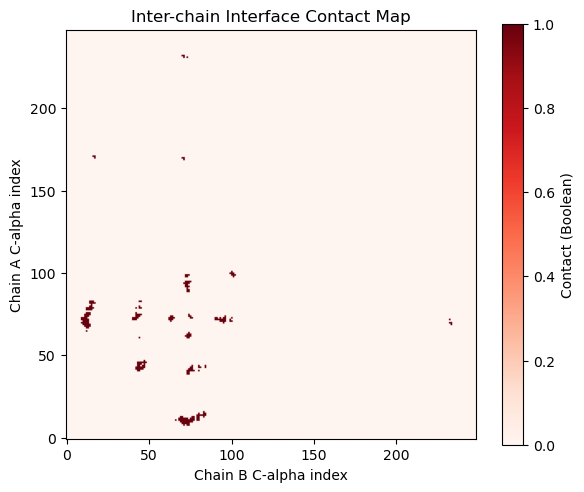
By passing both selection and selection_2, we can evaluate cross-set contact maps (for instance, the binding interface between two distinct protein chains):
ca_atoms_B = msm.select(molsys, selection='chain_id=="B" and atom_name=="CA"')
inter_contacts = msm.structure.get_contacts(
    molsys,
    selection=ca_atoms_A,
    selection_2=ca_atoms_B,
    threshold='1.0 nm'
)
print('Inter-chain contact map shape:', inter_contacts.shape)
print(f'Inter-chain contacts (< 1.0 nm): {np.sum(inter_contacts)}')
Inter-chain contact map shape: (1, 248, 249)
Inter-chain contacts (< 1.0 nm): 279
fig, ax = plt.subplots(figsize=(6, 5))
im = ax.imshow(inter_contacts[0], cmap='Reds', origin='lower')
ax.set_title('Inter-chain Interface Contact Map')
ax.set_xlabel('Chain B C-alpha index')
ax.set_ylabel('Chain A C-alpha index')
plt.colorbar(im, ax=ax, label='Contact (Boolean)')
plt.tight_layout()
plt.show()
Computing contacts between atom-group centroids#
Using center_of_atoms=True, molsysmt.structure.get_contacts() calculates contacts between the geometric centroids of atom groups (such as entire amino acid residues) rather than single atoms:
groups_chainA = msm.get(molsys, element='group', selection='chain_id=="A"', atom_index=True)
centroid_contacts = msm.structure.get_contacts(
    molsys,
    selection=groups_chainA,
    center_of_atoms=True,
    threshold='0.8 nm'
)
print('Residue centroid contact map shape:', centroid_contacts.shape)
print(f'Residue centroid contacts (< 0.8 nm): {np.sum(centroid_contacts)}')
Residue centroid contact map shape: (1, 248, 248)
Residue centroid contacts (< 0.8 nm): 2776
Querying contact pairs list#
Setting output_type='pairs' and output_indices='atom' returns the contacting atom index pairs directly as a list instead of a full dense matrix:
contact_pairs = msm.structure.get_contacts(
    molsys,
    selection=ca_atoms_A,
    selection_2=ca_atoms_B,
    threshold='0.8 nm',
    output_type='pairs',
    output_indices='atom'
)
print(f'Total interacting atom pairs found: {len(contact_pairs[0])}')
print('First 5 interacting atom pairs (global atom indices):', contact_pairs[0][:5])
Total interacting atom pairs found: 103
First 5 interacting atom pairs (global atom indices): [[56, 2460], [78, 2440], [78, 2444], [78, 2449], [78, 2460]]
See also
Related Tools & References
Convert: Convert molecular systems between different forms with
molsysmt.basic.convert().Select: Select atoms and elements with
molsysmt.basic.select().Get: Query elements, atom indices, and attributes with
molsysmt.basic.get().Get distances: Calculate continuous inter-atomic distances with
molsysmt.structure.get_distances().Get minimum distances: Measure closest-approach distances with
molsysmt.structure.get_minimum_distances().Get neighbors: Query neighboring atoms and elements within distance cutoffs with
molsysmt.structure.get_neighbors().