

Get maximum distances#
Calculating maximum spatial distances between atom selections or molecular groups.
The function molsysmt.structure.get_maximum_distances() calculates the maximum distance (such as molecular diameter or span) and identifies the furthest atom pair between selections across single or multiple trajectory structures.
Added in version 1.0.0.
API documentation
Follow this link for a detailed description of the input arguments, raised errors, and returned objects of this function: molsysmt.structure.get_maximum_distances().
Basic usage#
Let’s show how to calculate the maximum spatial span (diameter) of a peptide over a trajectory:
import molsysmt as msm
import matplotlib.pyplot as plt
import pyunitwizard as puw
molsys = msm.convert(msm.systems['pentalanine']['traj_pentalanine.h5msm'])
Note
Demo Systems Catalog
This tutorial uses demonstration datasets provided by MolSysMT. To explore the full catalog of bundled systems, forms, and file paths, visit the Demo Systems guide.
We calculate the maximum distance across all atoms in the system using molsysmt.structure.get_maximum_distances():
pairs, max_distances = msm.structure.get_maximum_distances(molsys)
print('Pairs array shape:', pairs.shape)
print('Maximum distances shape:', max_distances.shape)
print(f'System diameter at frame 0: {max_distances[0]:.3f} (between atom {pairs[0,0]} and {pairs[0,1]})')
Pairs array shape: (5000, 2)
Maximum distances shape: (5000,)
System diameter at frame 0: 1.610 nanometer (between atom 3 and 61)
Plotting maximum span time series#
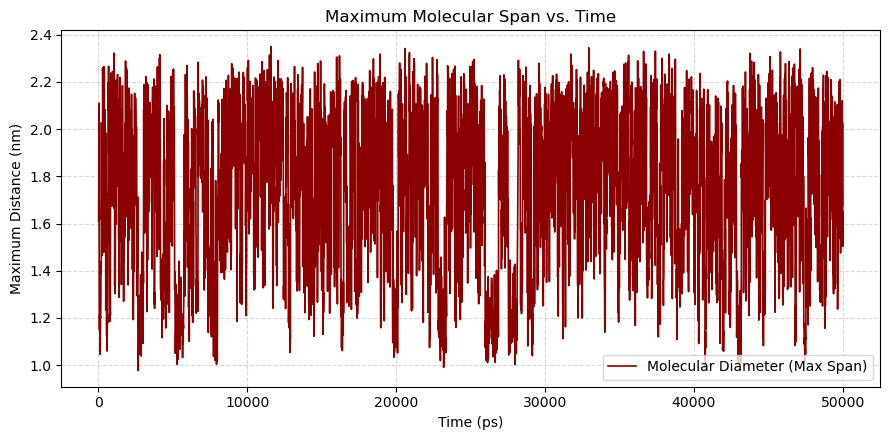
We plot the maximum system span over trajectory time to monitor conformational extension:
time = msm.get(molsys, element='system', time=True)
time_val = puw.get_value(time, to_unit='ps')
dist_val = puw.get_value(max_distances, to_unit='nm')

plt.figure(figsize=(9, 4.5))
plt.plot(time_val, dist_val, color='darkred', lw=1.2, label='Molecular Diameter (Max Span)')
plt.xlabel('Time (ps)')
plt.ylabel('Maximum Distance (nm)')
plt.title('Maximum Molecular Span vs. Time')
plt.grid(True, linestyle='--', alpha=0.5)
plt.legend()
plt.tight_layout()
plt.show()
Computing maximum distances between atom sets#
We can find the maximum separation between two separate groups of atoms (e.g. between terminal residues 0 and 4):
pairs_sets, max_d_sets = msm.structure.get_maximum_distances(molsys, selection='group_index==0', selection_2='group_index==4')
print(f'Max distance between terminal residues at frame 0: {max_d_sets[0]:.3f} (atoms {pairs_sets[0,0]} and {pairs_sets[0,1]})')
Max distance between terminal residues at frame 0: 1.297 nanometer (atoms 3 and 9)
Computing maximum distances between group centers#
Setting center_of_atoms=True and center_of_atoms_2=True measures the maximum distance between group centroids:
groups = msm.get(molsys, element='group', atom_index=True)
pairs_cent, max_d_cent = msm.structure.get_maximum_distances(molsys, selection=groups[0], selection_2=groups[-1], center_of_atoms=True, center_of_atoms_2=True)
print(f'Max centroid distance at frame 0: {max_d_cent[0]:.3f}')
Max centroid distance at frame 0: 1.430 nanometer
Measuring maximum displacements across structures#
Using pairs=True between different structures identifies the atom that underwent the largest displacement between consecutive time frames:
pairs_disp, max_disp = msm.structure.get_maximum_distances(molsys, structure_indices=[0, 1], structure_indices_2=[1, 2], pairs=True)
print(f'Atom {pairs_disp[0]} had the maximum displacement ({max_disp[0]:.4f}) between frames 0 and 1.')
print(f'Atom {pairs_disp[1]} had the maximum displacement ({max_disp[1]:.4f}) between frames 1 and 2.')
Atom 22 had the maximum displacement (1.0493 nanometer) between frames 0 and 1.
Atom 0 had the maximum displacement (1.3950 nanometer) between frames 1 and 2.
See also
Related Tools & References
Convert: Convert molecular systems between different forms with
molsysmt.basic.convert().Get: Query system time and structural attributes with
molsysmt.basic.get().Get distances: Compute full pairwise distance matrices with
molsysmt.structure.get_distances().Get minimum distances: Find the closest separation between elements with
molsysmt.structure.get_minimum_distances().Get radius of gyration: Measure spatial compactness with
molsysmt.structure.get_radius_of_gyration().