

Get dihedral angles#
Calculating dihedral and torsional angles from atom quartets.
The function molsysmt.structure.get_dihedral_angles() calculates dihedral angles defined by four consecutively bonded atoms \((A, B, C, D)\), measuring the angle between planes \((A, B, C)\) and \((B, C, D)\).
Added in version 1.0.0.
API documentation
Follow this link for a detailed description of the input arguments, raised errors, and returned objects of this function: molsysmt.structure.get_dihedral_angles().
Basic usage#
Let’s measure the backbone \(\phi\) dihedral angles of Met-enkephalin:
import molsysmt as msm
import pyunitwizard as puw
import matplotlib.pyplot as plt
molsys = msm.convert(msm.systems['Met-enkephalin']['met_enkephalin.h5msm'])
Note
Demo Systems Catalog
This tutorial uses demonstration datasets provided by MolSysMT. To explore the full catalog of bundled systems, forms, and file paths, visit the Demo Systems guide.
We query the backbone \(\phi\) atom quartets using molsysmt.topology.get_dihedral_quartets() and calculate their angles:
phi_quartets = msm.topology.get_dihedral_quartets(molsys, phi=True)
phi_angles = msm.structure.get_dihedral_angles(molsys, dihedral_quartets=phi_quartets)
print('Phi angles (degrees):', puw.convert(phi_angles, to_unit='degrees'))
Phi angles (degrees): [[-179.99977050951892 -179.9997685580422 -179.99976916196186 -179.99977065567504]] degree
Measuring sidechain dihedral angles#
In addition to backbone angles, sidechain torsional angles (such as \(\chi_1, \chi_2\)) or custom quartets can be queried and evaluated:
chi1_quartets = msm.topology.get_dihedral_quartets(molsys, chi1=True)
chi1_angles = msm.structure.get_dihedral_angles(molsys, dihedral_quartets=chi1_quartets)
print(f'Identified {len(chi1_quartets)} chi1 quartets.')
print('Chi1 dihedral angles (degrees):', puw.convert(chi1_angles, to_unit='degrees'))
Identified 3 chi1 quartets.
Chi1 dihedral angles (degrees): [[-179.99988816868782 -179.99988283064798 -179.99992497471675]] degree
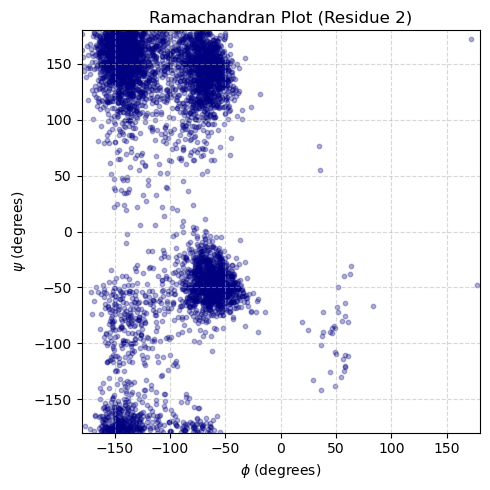
Ramachandran conformational distribution across structural ensembles#
By computing backbone \(\phi\) and \(\psi\) dihedral angles across an ensemble of structures, we can map the conformational space onto a classic 2D Ramachandran plot:
traj = msm.convert(msm.systems['pentalanine']['traj_pentalanine.h5msm'])
phi_q = msm.topology.get_dihedral_quartets(traj, phi=True)
psi_q = msm.topology.get_dihedral_quartets(traj, psi=True)

phi_vals = msm.structure.get_dihedral_angles(traj, dihedral_quartets=phi_q[1])
psi_vals = msm.structure.get_dihedral_angles(traj, dihedral_quartets=psi_q[1])

phi_deg = puw.get_value(puw.convert(phi_vals[:, 0], to_unit='degrees'))
psi_deg = puw.get_value(puw.convert(psi_vals[:, 0], to_unit='degrees'))
fig, ax = plt.subplots(figsize=(5, 5))
ax.scatter(phi_deg, psi_deg, alpha=0.3, s=10, c='navy')
ax.set_xlim(-180, 180)
ax.set_ylim(-180, 180)
ax.set_xlabel('$\\phi$ (degrees)')
ax.set_ylabel('$\\psi$ (degrees)')
ax.set_title('Ramachandran Plot (Residue 2)')
ax.grid(True, linestyle='--', alpha=0.5)
plt.tight_layout()
plt.show()
See also
Related Tools & References
Convert: Convert molecular systems between different forms with
molsysmt.basic.convert().Get dihedral quartets: Identify atom quartets for dihedral angles with
molsysmt.topology.get_dihedral_quartets().Set dihedral angles: Set dihedral angles to target values with
molsysmt.structure.set_dihedral_angles().Shift dihedral angles: Increment or decrement dihedral angles with
molsysmt.structure.shift_dihedral_angles().