

Get RMSD#
Calculating the root-mean-square deviation without prior spatial superposition.
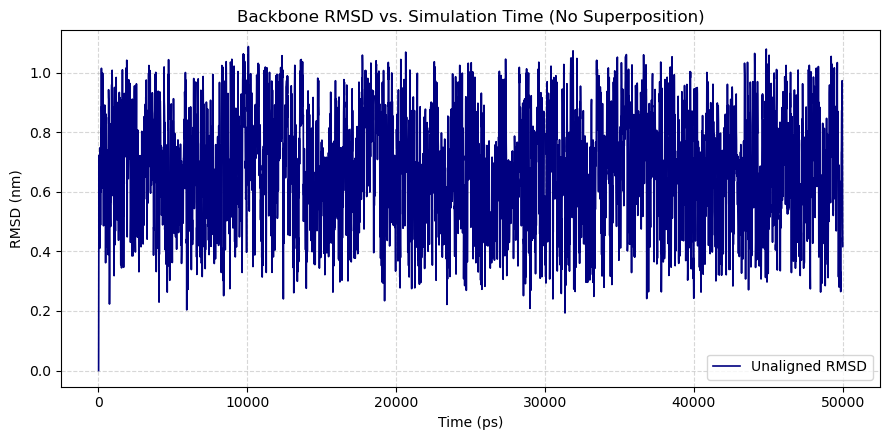
The function molsysmt.structure.get_rmsd() measures the root-mean-square deviation (RMSD) of atomic positions relative to a reference structure directly in the global coordinate frame without applying rigid-body translations or rotations.
Added in version 1.0.0.
API documentation
Follow this link for a detailed description of the input arguments, raised errors, and returned objects of this function: molsysmt.structure.get_rmsd().
Basic usage#
Let’s show how to calculate the raw RMSD of backbone atoms over a pentalanine trajectory relative to the initial frame:
import molsysmt as msm
import matplotlib.pyplot as plt
import pyunitwizard as puw
molsys = msm.convert(msm.systems['pentalanine']['traj_pentalanine.h5msm'])
Note
Demo Systems Catalog
This tutorial uses demonstration datasets provided by MolSysMT. To explore the full catalog of bundled systems, forms, and file paths, visit the Demo Systems guide.
We compute the unaligned RMSD using molsysmt.structure.get_rmsd() with reference_structure_index=0:
rmsd_raw = msm.structure.get_rmsd(molsys, selection='backbone', reference_structure_index=0)
print('RMSD array shape:', rmsd_raw.shape)
print(f'RMSD at frame 0 (self-comparison): {rmsd_raw[0]:.4f}')
print(f'RMSD at frame 1: {rmsd_raw[1]:.4f}')
RMSD array shape: (5000,)
RMSD at frame 0 (self-comparison): 0.0000 nanometer
RMSD at frame 1: 0.4440 nanometer
RMSD evolution across structural ensembles#
We plot the unaligned RMSD over simulation time to observe positional drift:
time = msm.get(molsys, element='system', time=True)
time_val = puw.get_value(time, to_unit='ps')
rmsd_val = puw.get_value(rmsd_raw, to_unit='nm')

plt.figure(figsize=(9, 4.5))
plt.plot(time_val, rmsd_val, color='navy', lw=1.2, label='Unaligned RMSD')
plt.xlabel('Time (ps)')
plt.ylabel('RMSD (nm)')
plt.title('Backbone RMSD vs. Simulation Time (No Superposition)')
plt.grid(True, linestyle='--', alpha=0.5)
plt.legend()
plt.tight_layout()
plt.show()
Comparing unaligned RMSD against optimal least-RMSD#
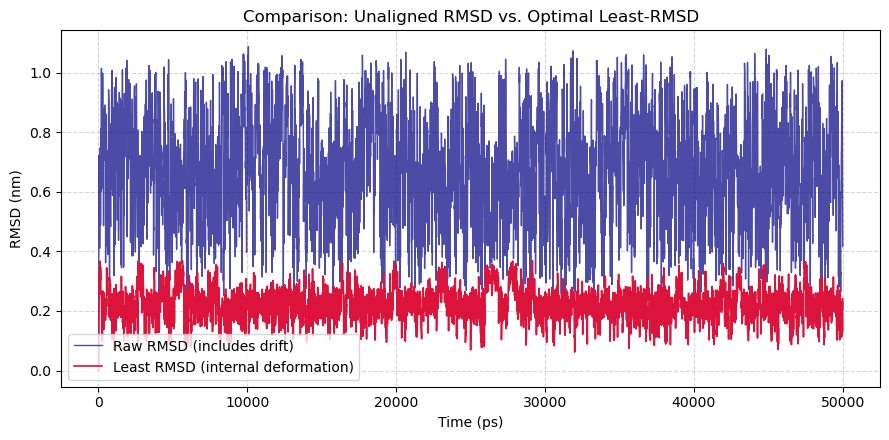
While molsysmt.structure.get_rmsd() includes overall translation and rotation drift, molsysmt.structure.get_least_rmsd() superposes each structure onto the reference before calculating deviation, isolating pure internal conformational changes:
rmsd_least = msm.structure.get_least_rmsd(molsys, selection='backbone', reference_structure_index=0)
rmsd_least_val = puw.get_value(rmsd_least, to_unit='nm')

plt.figure(figsize=(9, 4.5))
plt.plot(time_val, rmsd_val, color='navy', lw=1.0, alpha=0.7, label='Raw RMSD (includes drift)')
plt.plot(time_val, rmsd_least_val, color='crimson', lw=1.2, label='Least RMSD (internal deformation)')
plt.xlabel('Time (ps)')
plt.ylabel('RMSD (nm)')
plt.title('Comparison: Unaligned RMSD vs. Optimal Least-RMSD')
plt.grid(True, linestyle='--', alpha=0.5)
plt.legend()
plt.tight_layout()
plt.show()
See also
Related Tools & References
Convert: Convert molecular systems between different forms with
molsysmt.basic.convert().Get: Query system time and structural attributes with
molsysmt.basic.get().Get least RMSD: Compute optimal Kabsch superposition RMSD with
molsysmt.structure.get_least_rmsd().Least RMSD fit: Superpose coordinates onto a reference structure with
molsysmt.structure.least_rmsd_fit().Least RMSD align: Sequence-guided structural alignment for different topologies with
molsysmt.structure.least_rmsd_align().