

Wrap to PBC#
Wrapping atomic coordinates into the primary periodic boundary condition unit cell.
The function molsysmt.pbc.wrap_to_pbc() maps atomic coordinates back into the primary space-filling periodic unit cell.
Added in version 1.0.0.
API documentation
Follow this link for a detailed description of the input arguments, raised errors, and returned objects of this function: molsysmt.pbc.wrap_to_pbc().
Basic usage#
Let’s wrap a continuous trajectory into the primary periodic box:
import molsysmt as msm
import numpy as np
import matplotlib.pyplot as plt
molsys = msm.convert(msm.systems['two LJ particles']['traj_two_lj_particles.trjpk'], to_form='molsysmt.StructuresDict')
Note
Demo Systems Catalog
This tutorial uses demonstration datasets provided by MolSysMT. To explore the full catalog of bundled systems, forms, and file paths, visit the Demo Systems guide.
We inspect the continuous particle coordinate trajectory before wrapping:
fig, ax = plt.subplots(figsize=(7, 3.5))
time = molsys['time']
ax.plot(time, molsys['coordinates'][:, 0, 0], label='Particle 0 (X)', color='navy')
ax.plot(time, molsys['coordinates'][:, 1, 0], label='Particle 1 (X)', color='firebrick')
ax.set_title('Continuous Coordinates Before Wrapping')
ax.set_xlabel('Time (ps)')
ax.set_ylabel('Coordinate (nm)')
ax.legend()
ax.grid(True, linestyle='--', alpha=0.5)
plt.tight_layout()
plt.show()
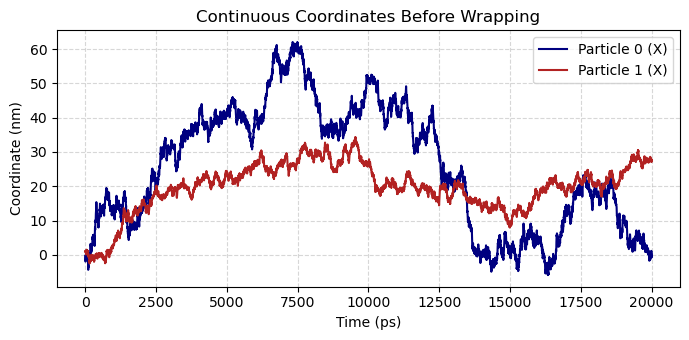
We fold all atomic coordinates into the primary periodic unit cell with molsysmt.pbc.wrap_to_pbc():
molsys_wrapped = msm.pbc.wrap_to_pbc(molsys)
Plotting the wrapped coordinates confirms that all coordinates now evolve strictly within the periodic cell boundaries:
fig, ax = plt.subplots(figsize=(7, 3.5))
ax.plot(time, molsys_wrapped['coordinates'][:, 0, 0], label='Particle 0 (X)', color='navy')
ax.plot(time, molsys_wrapped['coordinates'][:, 1, 0], label='Particle 1 (X)', color='firebrick')
ax.set_title('Wrapped Coordinates Inside Primary Periodic Cell')
ax.set_xlabel('Time (ps)')
ax.set_ylabel('Coordinate (nm)')
ax.legend()
ax.grid(True, linestyle='--', alpha=0.5)
plt.tight_layout()
plt.show()
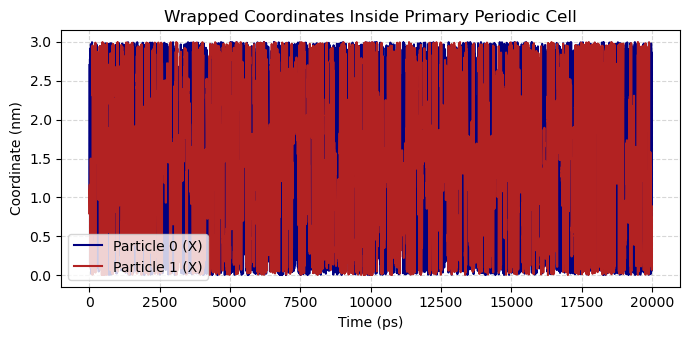
We verify that inter-particle distances evaluated under periodic boundary conditions remain invariant under wrapping:
dist_orig = msm.structure.get_distances(molsys, selection=0, selection_2=1, pbc=True)
dist_wrap = msm.structure.get_distances(molsys_wrapped, selection=0, selection_2=1, pbc=True)
print('Periodic distances invariant under wrapping:', np.allclose(dist_orig, dist_wrap))
Periodic distances invariant under wrapping: True
Preserving covalent bonds during macromolecular wrapping#
When wrapping macromolecular structures containing bonded atoms (such as solvated proteins or peptides), setting compact='component' ensures connected covalent blocks are reconstructed and translated together:
molsys_pep = msm.convert(msm.systems['Met-enkephalin']['met_enkephalin.h5msm'])
molsys_solv = msm.build.solvate(molsys_pep, box_shape='cubic', clearance='14.0 angstroms', engine='PDBFixer')
molsys_pep_wrapped = msm.pbc.wrap_to_pbc(molsys_solv, compact='component')
We visualize the wrapped solvated macromolecular system in 3D:
msm.view(molsys_pep_wrapped)
See also
Related Tools & References
Convert: Convert molecular systems with
molsysmt.basic.convert().Solvate: Solvate molecular systems with
molsysmt.build.solvate().Get distances: Measure structural distances with
molsysmt.structure.get_distances().View: Render 3D molecular views with
molsysmt.basic.view().Wrap to MIC: Wrap to minimum image convention with
molsysmt.pbc.wrap_to_mic().Unwrap: Restore spatial continuity with
molsysmt.pbc.unwrap().