

get_halogen_bonds#
Calculating sparse directional halogen-bond observations.
The experimental detector returns an independent Interactions analysis. Its descriptive method is distance_two_angles, with profile smarts_donor_acceptor. The ProLIF 2.2.2 geometric core adapts Auffinger et al. (2004); it is not the original paper’s element-specific distance rule.
Added in version 1.0.0.
API documentation
See molsysmt.interactions.halogen_bonds.get_halogen_bonds() for arguments, errors and returned data.
Basic usage#
Let’s show how this function works with three controlled structures containing a halogen donor and carbonyl acceptor. The middle structure is deliberately outside the cutoff. These synthetic coordinates illustrate the criterion and do not represent an optimized molecular geometry.
import molsysmt as msm
from rdkit import Chem
import numpy as np
from molsysmt import pyunitwizard as puw

molsys = msm.convert(Chem.MolFromSmiles('CCl.C=O'), to_form='molsysmt.MolSys')
xyz = np.array([[-.15, 0, 0], [0, 0, 0], [.36, .12*np.sqrt(.75), 0], [.30, 0, 0]])
coordinates = np.repeat(xyz[None], 3, axis=0)
coordinates[1, [2, 3]] += [0, .5, 0]
molsys.structures.append(coordinates=puw.quantity(coordinates, 'nm'))
analysis = msm.interactions.halogen_bonds.get_halogen_bonds(molsys, pbc=False)
print(analysis.occurrence_structures)
print(analysis.participant_roles)
print(analysis.query(structure_indices=[1]).n_interactions)
[0 2]
('donor', 'halogen', 'acceptor', 'acceptor_reference')
0
Understanding distance and orientation#
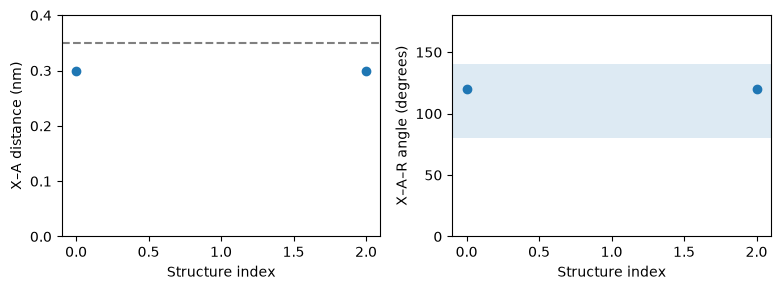
For D–X···A–R, D is the atom bonded to halogen X, A is the acceptor and R is its reference neighbor. The inclusive defaults are X–A ≤ 0.35 nm, D–X–A between 130° and 180°, and X–A–R between 80° and 140°. Each eligible R defines a distinct relation. Undefined angles are skipped. Exact boundaries may differ from the angstrom reference through floating-point rounding; no geometric tolerance is added.
import matplotlib.pyplot as plt
fig, axes = plt.subplots(1, 2, figsize=(8, 3))
axes[0].scatter(analysis.occurrence_structures, analysis.measurements['distance'])
axes[0].axhline(.35, color='gray', linestyle='--')
axes[0].set(xlabel='Structure index', ylabel='X–A distance (nm)', ylim=(0, .4))
axes[1].scatter(analysis.occurrence_structures, np.rad2deg(analysis.measurements['acceptor_angle']))
axes[1].axhspan(80, 140, alpha=.15)
axes[1].set(xlabel='Structure index', ylabel='X–A–R angle (degrees)', ylim=(0, 180))
fig.tight_layout()
Selecting structures and participating atoms#
Repeated structure indices are evaluated once. All four roles count: internal requires every participant, incident any participant, and between all participants inside two disjoint selections with at least one in each.
for mode, first, second in [('internal', [1, 3], None), ('incident', [2], None), ('between', [0, 1], [2, 3])]:
    scoped = msm.interactions.halogen_bonds.get_halogen_bonds(
        molsys, selection=first, selection_2=second, selection_mode=mode,
        structure_indices=[2, 0, 2], pbc=False)
    print(mode, scoped.n_interactions, scoped.evaluated_structure_indices)
print('Reference atom participates:', analysis.query(atom_indices=[2], mode='involving_selection').n_interactions)
internal 0 [0 2]
incident 2 [0 2]
between 2 [0 2]
Reference atom participates: 2
Choosing units and output representation#
Thresholds accept unitful quantities or length strings. Angular intervals contain two unitful values. Output measurement columns use explicit nm and radians regardless of the configured display-unit policy. Typed output carries all coverage, chemistry, evidence and producer metadata.
with puw.context(standard_units=['angstrom', 'degrees', 'ps', 'e']):
    typed = msm.interactions.halogen_bonds.get_halogen_bonds(
        molsys, distance_threshold='3.5 angstroms',
        donor_angle_range=puw.quantity([130, 180], 'degrees'),
        acceptor_angle_range=puw.quantity([80, 140], 'degrees'),
        output_type='molsysmt.InteractionsDict', pbc=False)
restored = msm.convert(typed, to_form='molsysmt.Interactions')
print(restored.measure_units)
assert restored.n_interactions == analysis.n_interactions
{'distance': 'nm', 'donor_angle': 'radians', 'acceptor_angle': 'radians', 'donor_halogen_distance': 'nm', 'acceptor_reference_distance': 'nm'}
Reconstructing the periodic observation#
With a valid box, consecutive D–X, X–A and A–R MIC vectors define one coherent observed chain anchored on D. A stored integer image adds image_vector @ box to its participant coordinate. This extension is not complete molecule unwrapping or ring closure.
periodic = msm.extract(molsys, structure_indices=[0])
box = np.eye(3)
lattice = np.array([[1, 0, 0], [0, 0, 0], [-1, 1, 0], [0, 1, 0]])
periodic.structures.coordinates = puw.quantity(coordinates[:1] + lattice @ box, 'nm')
periodic.structures.box = puw.quantity(box[None], 'nm')
observations = msm.interactions.halogen_bonds.get_halogen_bonds(periodic)
observed = puw.get_value(periodic.structures.coordinates, to_unit='nm')[0, observations.participant_atoms] + observations.image_vectors @ box
print(observations.image_vectors)
print('Observed X–A distance:', np.linalg.norm(observed[2] - observed[1]))
[[ 0  0  0]
 [ 1  0  0]
 [ 1 -1  0]
 [ 2 -1  0]]
Observed X–A distance: 0.30000000000000004
Separating chemical interpretation from geometry#
Use molsysmt.physchem.get_halogen_bond_sites() independently to inspect a halogenated ligand and peptide-fragment graph before proposing a geometry. Fluorine and positively charged acceptors are excluded by this profile. No attractive interaction energy or universal chemical accuracy is inferred.
sites = msm.physchem.get_halogen_bond_sites(Chem.MolFromSmiles('Clc1ccccc1.CC(=O)NCC(=O)O'))
print('Candidate donor pairs:', sites['donor_halogen_pairs'])
print('Candidate acceptor/reference pairs:', sites['acceptor_reference_pairs'])
Candidate donor pairs: [[1 0]]
Candidate acceptor/reference pairs: [[ 1  0]
 [ 1  2]
 [ 1  6]
 [ 2  3]
 [ 3  4]
 [ 4  5]
 [ 5  6]
 [ 9  8]
 [10  8]
 [10 11]
 [13 12]
 [14 12]]
Working from files and recording the analysis#
Attach explicitly under a name. Native and numeric-index H5MSM inputs deliver projected coordinate blocks through heavy_mode="auto" or "force"; rich file selections may require bounded eager loading. The complete chemical graph and accepted sparse output remain in memory. Match, candidate and result budgets raise explicitly; numerical estimates are not a process-RSS cap.
from tempfile import TemporaryDirectory
from pathlib import Path
with TemporaryDirectory() as directory:
    path = str(Path(directory) / 'halogens.h5msm')
    molsys.interactions = {**molsys.interactions, 'halogens': analysis}
    msm.convert(molsys, to_form=path)
    from_file = msm.interactions.halogen_bonds.get_halogen_bonds(path, structure_indices=[2, 0], pbc=False, heavy_mode='force')
    loaded = msm.convert(path, to_form='molsysmt.MolSys')
    assert loaded.interactions['halogens'].parameters == analysis.parameters
    print(from_file.evaluated_structure_indices)
print(analysis.software)
print([item['id'] for item in analysis.parameters['attribution']['items']])
[0 2]
{'molsysmt': '0.22.4+24.g42b487869', 'rdkit': '2025.09.5'}
['doi:10.1073/pnas.0407607101', 'doi:10.1186/s13321-021-00548-6', 'software:molsysmt:0.22.4+24.g42b487869', 'software:rdkit:2025.09.5']
The detached bibliography survives H5MSM and extraction. Optional application-owned Ackredit sessions credit completed calculations, including empty frames; reading saved results is not a new calculation. Water-mediated hydrogen bonds are a separate pending detector, not an automatic composition of these observations.
See also
Convert — form conversion with
molsysmt.basic.convert().get_halogen_bond_sites — chemical recognition with
molsysmt.physchem.get_halogen_bond_sites().Saving halogen-bond analyses — naming, saving and remapping observations.