

get_ionic_interactions#
Detecting minimum-distance observations between formal-charge centers.
Use selected-state chemical participants and an explicit distance cutoff to calculate a sparse analysis. This experimental method reports geometric proximity, not an electrostatic energy or a declared bond.
Added in version 1.0.0.
API documentation
See molsysmt.interactions.ionic.get_ionic_interactions() for the argument,
error, and result contracts.
Basic usage#
Let’s show how this function works with explicit formal-charge participants. First inspect a bundled molecular system: coordinates and residue names alone do not provide the state chemistry required by this method.
import molsysmt as msm
demo = msm.systems['pentalanine']['traj_pentalanine.h5msm']
try:
    msm.interactions.ionic.get_ionic_interactions(demo, '0.4 nm', pbc=False)
except msm.StructuralInconsistencyError:
    print('Explicit formal charges and complete bond chemistry are required.')
WARNING: H5MSM 0.4 is deprecated; reading remains supported. (Hint: Convert a copy to H5MSM 0.5 with molsysmt.h5msm.migrate_to_05(source, output). Docs: https://www.uibcdf.org/MolSysMT)
WARNING: H5MSM 0.4 is deprecated; reading remains supported. (Hint: Convert a copy to H5MSM 0.5 with molsysmt.h5msm.migrate_to_05(source, output). Docs: https://www.uibcdf.org/MolSysMT)
WARNING: H5MSM 0.4 is deprecated; reading remains supported. (Hint: Convert a copy to H5MSM 0.5 with molsysmt.h5msm.migrate_to_05(source, output). Docs: https://www.uibcdf.org/MolSysMT)
Explicit formal charges and complete bond chemistry are required.
Note
Demo Systems Catalog
This example uses Demo Systems. The clean failure above does not automatically parameterize or repair the system.
Construct a small analytical ensemble containing sodium, chloride, and potassium. The connectivity assumption is explicit: these isolated ions have no covalent bonds. The 0.4 nm cutoff is chosen for this example, not supplied as a universal scientific default.
import numpy as np
from molsysmt import pyunitwizard as puw
from molsysmt.native import MolSys, Topology

molsys = MolSys()
molsys.topology = Topology(n_atoms=3)
molsys.topology.atoms['atom_type'] = ['Na', 'Cl', 'K']
msm.set(molsys, element='atom', formal_charge=[1, -1, 1])
coordinates = np.array([
    [[0,0,0], [0.3,0,0], [0.6,0,0]],
    [[0,0,0], [2,0,0], [4,0,0]],
    [[0,0,0], [0.2,0,0], [0.8,0,0]],
])
molsys.structures.append(coordinates=puw.quantity(coordinates, 'nm'))

analysis = msm.interactions.ionic.get_ionic_interactions(
    molsys, '0.4 nm', pbc=False, assume_complete_connectivity=True)
print(analysis.n_interactions)
print(analysis.measurements['distance'])
print(analysis.measure_units)
assert analysis.n_interactions == 3
assert not molsys.interactions
3
[0.3 0.3 0.2]
{'distance': 'nm', 'positive_charge': 'e', 'negative_charge': 'e'}
Choosing structures#
Repeated structure indices are evaluated once in sorted order. A frame with no occurrences remains evaluated; an omitted frame remains unevaluated. All occurrence and participant indices address the original input system.
selected = msm.interactions.ionic.get_ionic_interactions(
    molsys, '0.4 nm', structure_indices=[2, 0, 2], pbc=False,
    assume_complete_connectivity=True)
print(selected.evaluated_structure_indices.tolist())
empty = analysis.query(structure_indices=[1]).to_dict()
print(empty['evaluated_structure_indices'].tolist())
print(empty['occurrence_indices'].tolist())
assert selected.evaluated_structure_indices.tolist() == [0, 2]
assert empty['evaluated_structure_indices'].tolist() == [1]
[0, 2]
[1]
[]
Choosing calculation scope#
internal searches only complete centers in the first selection. incident
searches interactions involving those centers with any eligible center in the
system, including internal contacts. between requires two disjoint selections.
The detector rejects selections that cut a nonzero compound center.
def calculate(**kwargs):
    return msm.interactions.ionic.get_ionic_interactions(
        molsys, '0.4 nm', pbc=False, assume_complete_connectivity=True, **kwargs)

internal = calculate(selection=[0, 1], selection_mode='internal')
incident = calculate(selection=[1], selection_mode='incident')
between = calculate(selection=[0, 2], selection_2=[1], selection_mode='between')
print(internal.n_interactions, incident.n_interactions, between.n_interactions)
assert (internal.n_interactions, incident.n_interactions, between.n_interactions) == (2, 3, 3)
print(analysis.query(structure_indices=[2], atom_indices=[0]).n_interactions)
2 3 3
1
Inspecting variable occurrence counts#
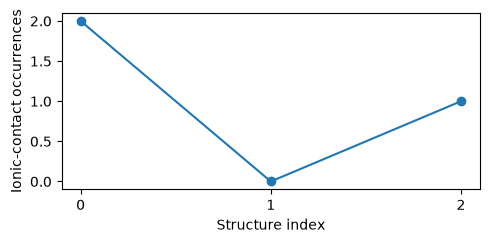
The counts below reflect this constructed ensemble. Zero is a valid result; missing chemistry would instead raise an error.
import matplotlib.pyplot as plt

counts = [analysis.query(structure_indices=[frame]).n_interactions for frame in range(3)]
fig, ax = plt.subplots(figsize=(5, 2.5))
ax.plot(range(3), counts, 'o-')
ax.set(xlabel='Structure index', ylabel='Ionic-contact occurrences', xticks=[0, 1, 2])
fig.tight_layout()
assert counts == [2, 0, 1]
Measuring compound participants#
Guanidinium and carboxylate illustrate charged groups found in arginine and acidic residues. Here you use explicit small-molecule chemistry as an analogue, with constructed coordinates rather than an experimental protein structure. This optional preparation uses RDKit through the existing conversion route.
The positive participant includes the central carbon and three nitrogens; the negative one includes its carbon and two oxygens. Minimum distances use nitrogens and oxygens, respectively. Several close reference pairs still produce one occurrence per center pair.
topology = msm.convert('smiles:NC(=[NH2+])N.CC(=O)[O-]', to_form='molsysmt.Topology')
molsys_A = msm.convert(topology, to_form='molsysmt.MolSys')
molsys_A.structures.append(coordinates=puw.quantity(np.array([[
    [0,0,0], [0,0.05,0], [0,-0.05,0], [0.05,0,0],
    [0.4,0,0], [0.3,0,0], [0.25,0,0], [0.35,0,0],
]]), 'nm'))
compound = msm.interactions.ionic.get_ionic_interactions(molsys_A, '0.4 nm', pbc=False)
print(compound.relation(0))
print(compound.measurements['distance'])
assert compound.n_interactions == 1
assert compound.query(atom_indices=[1], mode='involving_selection').n_interactions == 1
{'interaction_type': 'ionic_contact', 'participants': [{'role': 'positive', 'atom_indices': array([0, 1, 2, 3])}, {'role': 'negative', 'atom_indices': array([5, 6, 7])}]}
[0.2]
Choosing a chemical state#
Recognition uses one state throughout the requested structures. Changing the formal charges changes the chemical participants without changing coordinates. The new state below declares all three isolated-ion sites neutral solely as an analytical control. It is not an inferred physical transformation.
neutral_index = molsys.chemical_states.append_state()
msm.set(molsys, element='atom', chemical_state=neutral_index, formal_charge=[0, 0, 0])
neutral = calculate(chemical_state=neutral_index)
print(neutral.n_interactions, neutral.parameters['chemical_state_index'])
assert neutral.n_interactions == 0
assert calculate(chemical_state=0).n_interactions == 3
0 1
Applying periodic images#
When a box is present, the method uses MIC geometry. Add the reported lattice vector multiplied by the row-vector box to every atom of the corresponding participant. The positive participant is the reference image.
Compound participants must already be whole in the source coordinates under the documented anchor-relative MIC condition. Split groups raise an explicit error: reconstructing them silently would make their saved image ambiguous.
molsys_B = MolSys()
molsys_B.topology = Topology(n_atoms=2)
molsys_B.topology.atoms['atom_type'] = ['Na', 'Cl']
msm.set(molsys_B, element='atom', formal_charge=[1, -1])
xyz = np.array([[[0.1, 0, 0], [0.9, 0, 0]]])
box = np.eye(3)[None]
molsys_B.structures.append(coordinates=puw.quantity(xyz, 'nm'), box=puw.quantity(box, 'nm'))
periodic = msm.interactions.ionic.get_ionic_interactions(
    molsys_B, '0.4 nm', assume_complete_connectivity=True)
displayed = xyz[0] + periodic.image_vectors @ box[0]
print(periodic.image_vectors.tolist())
print(periodic.measurements['distance'])
assert np.isclose(np.linalg.norm(displayed[1] - displayed[0]), 0.2)
[[0, 0, 0], [-1, 0, 0]]
[0.2]
Exporting and attaching results#
The default result is an Interactions analysis. Request InteractionsDict
for its typed serialization payload, or use the public conversion. Attach a
result explicitly under a name; the detector leaves existing analyses intact.
dictionary = calculate(output_type='molsysmt.InteractionsDict')
restored = msm.convert(dictionary, to_form='molsysmt.Interactions')
molsys.interactions = {**molsys.interactions, 'ionic': analysis}
print(list(molsys.interactions))
print(restored.software)
assert restored.n_interactions == analysis.n_interactions
['ionic']
{'molsysmt': '0.22.4+24.g42b487869'}
Calculating in blocks#
heavy_mode='auto' chooses coordinate blocks when the source or selected-buffer
working estimate requires them. force requests blocks; off requests eager
execution within the budget. Chunked input supports native MolSys and H5MSM
0.5 paths with atom-index selections or 'all'. Rich string selections use
the eager route and are rejected for forced chunking.
The following small example limits blocks to two structures. Scientific observations and occurrence indices agree with the eager analysis. Execution parameters record the path and actual number of blocks.
with msm.configure.context(chunk_size=2):
    chunked = calculate(heavy_mode='force')
    eager = calculate(heavy_mode='off')
np.testing.assert_array_equal(chunked.occurrence_structures, eager.occurrence_structures)
np.testing.assert_allclose(chunked.measurements['distance'], eager.measurements['distance'])
print(chunked.execution_records[0]['details']['execution'], chunked.execution_records[0]['details']['execution_chunks'])
chunked 2
Validation scope#
The bounded method has independent controls using the bundled Trp-cage (38 models) and villin HP35 coordinates with explicitly declared formal-charge states. Whole centers and their minimum distances are checked independently; the tests also cover empty frames, atom/frame selections, periodic image reconstruction, and H5MSM persistence. These controls validate the stated geometric rule for those states, not experimental protonation, interaction energies, or universal chemical recognition. The API remains experimental.
Understanding limits#
The recognizer uses formal charges, bounded carboxyl/guanidine rules and directly connected charged atoms. Atomic or generic cluster labels do not resolve phosphate, sulfate or aromatic delocalization universally. Their expansion is tracked by MolSysMT #262. Intramolecular contacts are included; directly covalently linked centers are excluded. Dative bonds do not impose that exclusion. Only one minimum-image observation is returned per center pair, not every possible periodic image.
The calculation prepares chemistry once. For an H5MSM 0.5 input with index selections, it loads topology, chemical states and association metadata while reading only selected coordinate blocks and no saved analyses. These domains must declare identity atom-axis links. A structure-assigned state must be the same for all requested frames.
The complete sparse analysis remains in memory. Numerical working estimates
allocate one quarter of max_ram_usage to coordinate blocks, one eighth per
candidate search and one half to sparse accumulation/packing. A calculation
fails clearly when these estimates cannot fit; it does not return partial
coverage or silently switch methods. These estimates do not bound process RSS:
source coordinates, chemistry tables, Python objects and library overhead also
occupy RAM. Conservative candidate bounds can reject a small budget even when
actual neighbors would be sparse. No incremental result writer is provided.
The cutoff includes a one-float64-ULP allowance for unit-conversion roundoff.
See also
Related Tools & References
molsysmt.basic.convert()— preparing supported forms and serializing results.molsysmt.physchem.get_charge_centers()— inspecting chemical participants.Saving ionic analyses — saving a named analysis with its system.