

Get attributed hydrogen bonds#
Calculating sparse observations with named hydrogen-bond criteria.
Each relation has three singleton roles: donor, hydrogen and acceptor. Choose a known criterion explicitly and retain its method reference, producer software, units, evaluated coverage and observed periodic images. Buch and Luzard–Chandler remain available with their existing defaults.
Added in version 1.0.0.
API documentation
See molsysmt.interactions.hbonds.get_hbonds() for arguments, units, outputs and errors.
Basic usage#
Let’s show how this function works with a controlled water-pair ensemble, including one structure with no accepted observations. This demonstrates geometry and coverage, not thermodynamic stability of the supplied coordinates.
import molsysmt as msm
import numpy as np
from rdkit import Chem
from molsysmt import pyunitwizard as puw

molsys = msm.convert(Chem.AddHs(Chem.MolFromSmiles('O.O')), to_form='molsysmt.MolSys')
xyz = np.array([[0, 0, 0], [.28, 0, 0], [.1, 0, 0], [0, .1, 0], [.28, .1, 0], [.28, 0, .1]])
coordinates = np.repeat(xyz[None], 3, axis=0)
coordinates[1, [1, 4, 5]] += [0, .4, 0]
molsys.structures.append(coordinates=puw.quantity(coordinates, 'nm'))
analysis = msm.interactions.hbonds.get_hbonds(molsys, pbc=False)
print(analysis.occurrence_structures.tolist())
print(analysis.evaluated_structure_indices.tolist())
print(analysis.relation(0))
assert analysis.occurrence_structures.tolist() == [0, 2]
[0, 2]
[0, 1, 2]
{'interaction_type': 'hbond', 'participants': [{'role': 'donor', 'atom_indices': array([0])}, {'role': 'hydrogen', 'atom_indices': array([2])}, {'role': 'acceptor', 'atom_indices': array([1])}]}
Choosing the scientific criterion#
DA denotes donor–acceptor distance; HA denotes hydrogen–acceptor distance. DHA is the angle at H and HDA is the angle at D, zero for a straight D–H…A arrangement.
Method / profile |
Default geometry |
Site recognition |
|---|---|---|
baker_hubbard |
HA <0.25 nm; DHA >120° |
MDTraj N/O rules |
wernet_nilsson |
DA <0.33 nm −0.000044 nm/degree² × HDA² |
MDTraj N/O rules |
donor_acceptor_distance_angle / elemental_fon |
DA ≤0.30 nm; DHA ≥135° |
CPPTRAJ F/O/N rules |
donor_acceptor_distance_angle / smarts_donor_acceptor |
DA ≤0.35 nm; DHA ≥130° |
ProLIF 2.2.2 SMARTS |
donor_acceptor_distance_angle / explicit_sites |
0.10 nm < DA ≤0.30 nm; DHA >150° |
Explicit sites required |
These are individual observations per structure. No occupancy/frequency, solvent, sidechain, energy or water-bridge filter is applied. CPPTRAJ source comparisons are inclusive despite its help text. Wernet–Nilsson follows MDTraj’s implemented curve; its literal extra comparison with 45 is in radians, not a 45° angular cutoff. The software selectors in the following loop exercise supported compatibility aliases.
profiles = {method: msm.interactions.hbonds.get_hbonds(molsys, method=method, pbc=False)
            for method in ('baker_hubbard', 'wernet_nilsson', 'cpptraj', 'prolif')}
explicit = msm.interactions.hbonds.get_hbonds(
    molsys, method='mdanalysis_geometry', donor_hydrogen_pairs=[[0, 2]],
    acceptor_atom_indices=[1], pbc=False)
print({method: result.n_interactions for method, result in profiles.items()})
print(explicit.parameters['method_reference'])
{'baker_hubbard': 2, 'wernet_nilsson': 2, 'cpptraj': 2, 'prolif': 2}
{'software': 'MDAnalysis', 'commit': '9531c6e157d0211bfcc086374e3da429d1e3c8d1', 'implementation': 'https://github.com/MDAnalysis/mdanalysis/blob/9531c6e157d0211bfcc086374e3da429d1e3c8d1/package/MDAnalysis/analysis/hydrogenbonds/hbond_analysis.py', 'documentation': 'https://docs.mdanalysis.org/stable/documentation_pages/analysis/hydrogenbonds.html'}
Inspecting structural observations#
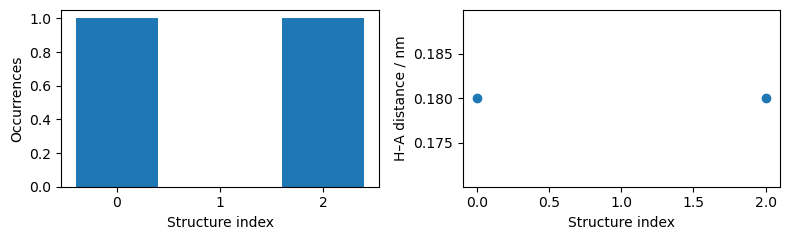
Measure columns align with occurrences. All distances are stored in nm and both angles in radians, independent of the session’s preferred display units.
import matplotlib.pyplot as plt
counts = [analysis.query(structure_indices=i).n_interactions for i in range(3)]
fig, axes = plt.subplots(1, 2, figsize=(8, 2.5))
axes[0].bar(range(3), counts)
axes[0].set(xlabel='Structure index', ylabel='Occurrences', xticks=range(3))
axes[1].plot(analysis.occurrence_structures, analysis.measurements['hydrogen_acceptor_distance'], 'o')
axes[1].set(xlabel='Structure index', ylabel='H–A distance / nm')
fig.tight_layout()
Combining structure and atom selections#
Repeated structure indices are evaluated once in sorted order. Internal calculations require all three atoms in S; incident calculations require any role in S. Between calculations require all atoms in the union of disjoint selections and at least one in each. A selected hydrogen therefore counts as participation.
selected = msm.interactions.hbonds.get_hbonds(molsys, structure_indices=[2, 0, 2], pbc=False)
internal = msm.interactions.hbonds.get_hbonds(molsys, selection=[0, 2], pbc=False)
incident = msm.interactions.hbonds.get_hbonds(molsys, selection=[2], selection_mode='incident', pbc=False)
between = msm.interactions.hbonds.get_hbonds(molsys, selection=[0, 2], selection_2=[1], selection_mode='between', pbc=False)
assert (internal.n_interactions, incident.n_interactions, between.n_interactions) == (0, 2, 2)
print(selected.evaluated_structure_indices.tolist())
print(analysis.query(atom_indices=[2], structure_indices=[2, 0]).to_dict()['occurrence_indices'])
assert analysis.query(structure_indices=1).n_interactions == 0
[0, 2]
[1 0]
Changing unitful cutoffs#
Use unit-bearing strings or PyUnitWizard quantities. Wernet–Nilsson permits changing the curve’s distance intercept but rejects a separate angle threshold. Supplying explicit sites overrides recognition and records that caller declaration.
with puw.context(standard_units=['angstrom', 'degrees', 'ps', 'e']):
    changed = msm.interactions.hbonds.get_hbonds(
        molsys, distance_threshold='2.5 angstrom', angle_threshold='120 degrees', pbc=False)
print(changed.measure_units)
assert changed.measure_units['dha_angle'] == 'radians'
{'donor_hydrogen_distance': 'nm', 'donor_acceptor_distance': 'nm', 'hydrogen_acceptor_distance': 'nm', 'dha_angle': 'radians', 'hda_angle': 'radians'}
Retaining the observed periodic image#
Box vectors are rows. Reconstruct each participant as raw coordinates plus
image_vector @ box; donor has zero image. At-H criteria use donor–H and H–acceptor
MIC vectors; Wernet–Nilsson anchors both vectors at donor. DA profiles fail if
independent DA and H-centered images cannot describe one coherent triplet.
CPPTRAJ additionally requires a whole donor–H pair, matching its original raw vector.
periodic = msm.extract(molsys, structure_indices=[0])
box = np.eye(3)
xyz_pbc = xyz.copy() + [.86, 0, 0]
xyz_pbc[[1, 4, 5]] -= box[0]
msm.set(periodic, coordinates=puw.quantity(xyz_pbc[None], 'nm'), box=puw.quantity(box[None], 'nm'))
observed = msm.interactions.hbonds.get_hbonds(periodic)
print(observed.image_vectors)
triplet = xyz_pbc[observed.participant_atoms] + observed.image_vectors @ box
assert np.isclose(np.linalg.norm(triplet[2]-triplet[1]), observed.measurements['hydrogen_acceptor_distance'][0])
[[0 0 0]
 [0 0 0]
 [1 0 0]]
Examining a biological system#
The bundled Trp-Cage structure includes indexed hydrogens. Elemental Baker–Hubbard recognition uses its declared graph; these observations do not imply universal acceptor chemistry or favorable interaction energy.
protein = Chem.MolFromPDBFile(str(msm.systems['Trp-Cage']['1l2y.pdb']), removeHs=False)
biological = msm.interactions.hbonds.get_hbonds(protein, pbc=False)
print(biological.n_interactions, biological.evaluated_structure_indices.tolist())
490 [0, 1, 2, 3, 4, 5, 6, 7, 8, 9, 10, 11, 12, 13, 14, 15, 16, 17, 18, 19, 20, 21, 22, 23, 24, 25, 26, 27, 28, 29, 30, 31, 32, 33, 34, 35, 36, 37]
Returning, attaching and saving analyses#
The typed dictionary preserves sparse columns, provenance and units. Attachment is explicit and named; other analyses are retained. See Saving hydrogen-bond analyses for persistence and remapping through public H5MSM conversion.
columns = msm.interactions.hbonds.get_hbonds(molsys, output_type='molsysmt.InteractionsDict', pbc=False)
restored = msm.convert(columns, to_form='molsysmt.Interactions')
molsys.interactions = {**molsys.interactions, 'water_hbonds': analysis}
assert restored.n_interactions == analysis.n_interactions
print(list(molsys.interactions), analysis.software)
['water_hbonds'] {'molsysmt': '0.21.0+606.ga03eb4bf6'}
Processing coordinate blocks#
Native and H5MSM coordinate routes project required atoms and frames. Other supported forms use ordinary getters within the eager estimate. Rich H5MSM selections require eager materialization; index selections permit the projected route. The sparse result stays resident in RAM, and candidate/result estimates can fail explicitly. Neither chunk size nor the working budget caps process RSS or caller-owned coordinates.
with msm.configure.context(chunk_size=1):
    blocked = msm.interactions.hbonds.get_hbonds(molsys, heavy_mode='force', pbc=False)
assert blocked.occurrence_structures.tolist() == analysis.occurrence_structures.tolist()
print(blocked.execution_records[0]['details']['execution_chunks'])
3
See also
Related Tools & References
Getting hydrogen-bond sites — chemical candidates,
molsysmt.physchem.get_hbond_sites().Saving hydrogen-bond analyses — naming, persistence and remapping.
Baker and Hubbard, 1984 and Wernet et al., 2004 — criterion references.
Retaining scientific attribution#
The analysis records method, profile, method_definition and a compact
bibliography in analysis.parameters['attribution']. Bibliographic roles distinguish
the scientific criterion, reference implementation and software actually executed.
These records survive typed conversion and H5MSM 0.5 persistence. Loading the file
does not claim a new calculation. With optional Ackredit installed, completed
calculations also contribute to the caller’s workflow session. No hooks, online DOI
lookup or journal are enabled by MolSysMT.
See Methods and attribution for the
canonical method/profile table, compatible aliases and optional reporting example.
print(analysis.parameters['method'], analysis.parameters['profile'])
print([(item['title'], item['roles']) for item in analysis.parameters['attribution']['items']])
baker_hubbard nitrogen_oxygen
[('Hydrogen bonding in globular proteins', ['scientific_criterion']), ('MDTraj: A Modern Open Library for the Analysis of Molecular Dynamics Trajectories', ['reference_implementation']), ('MolSysMT', ['executed_software'])]