

get_water_bridges#
Observing simultaneous hydrogen bonds through one or two waters.
The descriptive method hbond_water_path composes observed hydrogen-bond legs. The default order=1 observes exactly one water; order=2 observes exactly two. The earlier two_hbonds_one_water selector remains valid for order one. Choose the leg science explicitly; the default is Baker-Hubbard. This follows the water-mediated path concept used by ProLIF and MDAnalysis, with MolSysMT atom-level identities and no claim of complete residue/network pipeline parity.
Added in version 1.0.0.
API documentation
See molsysmt.interactions.water_bridges.get_water_bridges() for arguments, outputs and explicit failures.
Basic usage#
Two carbonyl fragments mimic hydration at a ligand or protein interface. Controlled coordinates give two straight O-H-O branches and an evaluated empty middle frame; they are not an optimized binding pose.
import numpy as np
import molsysmt as msm
from rdkit import Chem
molsys = msm.convert(Chem.AddHs(Chem.MolFromSmiles('O.C=O.C=O')), to_form='molsysmt.MolSys')
xyz = np.zeros((3, 11, 3))
xyz[:,:,2] = np.arange(11) * 3 + 3
xyz[:,0] = [0,0,0]
xyz[:,5] = [.1,0,0]
xyz[:,6] = [0,.1,0]
xyz[:,2] = [.3,0,0]
xyz[:,4] = [0,.3,0]
xyz[1,4] += 2
molsys.structures.append(coordinates=msm.pyunitwizard.quantity(xyz, 'nm'))
analysis = msm.interactions.water_bridges.get_water_bridges(molsys, pbc=False)
print('Observations:', analysis.n_interactions, 'evaluated frames:', analysis.evaluated_structure_indices.tolist())
Observations: 2 evaluated frames: [0, 1, 2]
Reading branch roles#
Each path stores two directed D-H-A triples as six singleton roles. The shared water oxygen appears twice, preserving both branches. An unused water H is not an additional participant. Water may donate both branches, accept both, or donate one and accept one.
print(analysis.relation(0))
print(analysis.participant_atoms, analysis.measure_units)
print('Water incident:', analysis.query(atom_indices=[0], mode='involving_selection').n_interactions)
print('Water alone internal:', analysis.query(atom_indices=[0], mode='within_selection').n_interactions)
{'interaction_type': 'water_bridge', 'participants': [{'role': 'leg_1_donor', 'atom_indices': array([0])}, {'role': 'leg_1_hydrogen', 'atom_indices': array([5])}, {'role': 'leg_1_acceptor', 'atom_indices': array([2])}, {'role': 'leg_2_donor', 'atom_indices': array([0])}, {'role': 'leg_2_hydrogen', 'atom_indices': array([6])}, {'role': 'leg_2_acceptor', 'atom_indices': array([4])}]}
[0 5 2 0 6 4] {'leg_1_donor_hydrogen_distance': 'nm', 'leg_1_donor_acceptor_distance': 'nm', 'leg_1_hydrogen_acceptor_distance': 'nm', 'leg_1_dha_angle': 'radians', 'leg_1_hda_angle': 'radians', 'leg_2_donor_hydrogen_distance': 'nm', 'leg_2_donor_acceptor_distance': 'nm', 'leg_2_hydrogen_acceptor_distance': 'nm', 'leg_2_dha_angle': 'radians', 'leg_2_hda_angle': 'radians'}
Water incident: 2
Water alone internal: 0
Selecting all participants#
Internal requires all actual leg atoms, including the mediator. An endpoint-only set needs incident. Between requires every participant in the union, with at least one in each disjoint selection; include water atoms explicitly. Queries do not silently create endpoint semantics.
actual = np.unique(analysis.participant_atoms)
for mode, first, second in [('internal',actual,None), ('incident',[2],None), ('between',[0],np.setdiff1d(actual,[0]))]:
    result = msm.interactions.water_bridges.get_water_bridges(molsys, selection=first, selection_2=second, selection_mode=mode, structure_indices=[2,0,2], pbc=False)
    print(mode, result.n_interactions, result.evaluated_structure_indices.tolist())
print('Endpoints-only internal:', msm.interactions.water_bridges.get_water_bridges(molsys, selection=[2,4], pbc=False).n_interactions)
internal 2 [0, 2]
incident 2 [0, 2]
between 2 [0, 2]
Endpoints-only internal: 0
Choosing the science for each leg#
Baker-Hubbard uses H-A <0.25 nm and D-H-A >120 degrees. Wernet-Nilsson uses its angular distance curve. The descriptive D-A/angle method can use the pinned SMARTS profile. Neither path identity nor geometry is inferred from a residue label. explicit_sites is unavailable in this wrapper.
for method, profile in [('baker_hubbard',None), ('wernet_nilsson',None), ('donor_acceptor_distance_angle','smarts_donor_acceptor')]:
    result = msm.interactions.water_bridges.get_water_bridges(molsys, hbond_method=method, hbond_profile=profile, pbc=False)
    print(method, result.n_interactions, result.parameters['hbond_profile'])
with msm.pyunitwizard.context(standard_units=['angstrom','degrees','ps','e']):
    result = msm.interactions.water_bridges.get_water_bridges(molsys, distance_threshold='2.5 angstrom', angle_threshold='120 degrees', pbc=False)
print(result.measure_units)
baker_hubbard 2 nitrogen_oxygen
wernet_nilsson 2 nitrogen_oxygen
donor_acceptor_distance_angle 2 smarts_donor_acceptor
{'leg_1_donor_hydrogen_distance': 'nm', 'leg_1_donor_acceptor_distance': 'nm', 'leg_1_hydrogen_acceptor_distance': 'nm', 'leg_1_dha_angle': 'radians', 'leg_1_hda_angle': 'radians', 'leg_2_donor_hydrogen_distance': 'nm', 'leg_2_donor_acceptor_distance': 'nm', 'leg_2_hydrogen_acceptor_distance': 'nm', 'leg_2_dha_angle': 'radians', 'leg_2_hda_angle': 'radians'}
Inspecting structural observations#
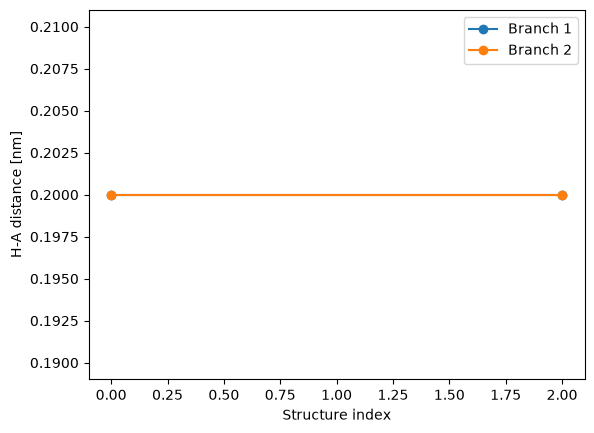
The two branches must exist in the same frame. Two observations in different frames are not a path. Alternative hydrogens and bifurcated legs remain distinct exact branch pairs; repeated queries do not duplicate them.
import matplotlib.pyplot as plt
for branch in (1,2):
    plt.plot(analysis.occurrence_structures, analysis.measurements[f'leg_{branch}_hydrogen_acceptor_distance'], 'o-', label=f'Branch {branch}')
plt.xlabel('Structure index'); plt.ylabel('H-A distance [nm]'); plt.legend(); plt.show()
print('Evaluated empty:', analysis.query(structure_indices=[1]).to_dict()['evaluated_structure_indices'])
Evaluated empty: [1]
Retaining coherent periodic geometry#
Each branch retains its observed geometry. The second is translated onto the first branch water-oxygen image, then the six roles are anchored on the first role. Conflicting images of a repeated atom raise. Image shifts reproduce observations; they do not reconstruct the whole molecule.
periodic = msm.convert(molsys, to_form='molsysmt.MolSys')
shifted = msm.pyunitwizard.get_value(periodic.structures.coordinates, to_unit='nm').copy()
shifted[:,5] += [1,0,0]
shifted[:,4] += [0,1,0]
periodic.structures.coordinates = msm.pyunitwizard.quantity(shifted, 'nm')
periodic.structures.box = msm.pyunitwizard.quantity(np.repeat(np.eye(3)[None],3,axis=0), 'nm')
observed = msm.interactions.water_bridges.get_water_bridges(periodic, structure_indices=[0])
print(observed.image_vectors)
print(observed.measurements['leg_2_hydrogen_acceptor_distance'])
[[ 0  0  0]
 [-1  0  0]
 [ 0  0  0]
 [ 0  0  0]
 [ 0  0  0]
 [ 0 -1  0]]
[0.2]
Inspecting provenance and alternate output#
The original producer versions and the entire attributed leg specification survive typed conversion. Reading a saved result is not a newly performed scientific calculation.
print(analysis.software, analysis.parameters['hbond_parameters']['attribution']['items'][0]['roles'])
typed = msm.interactions.water_bridges.get_water_bridges(molsys, pbc=False, output_type='molsysmt.InteractionsDict')
print(msm.convert(typed, to_form='molsysmt.Interactions').n_interactions)
{'molsysmt': '0.22.4+24.g42b487869', 'rdkit': '2025.09.5'} ['scientific_criterion']
2
Streaming the coordinate input#
The leg detector streams projected native/H5MSM coordinates. Accepted legs and bridges must fit in memory; sparse fan-out is bounded during joining. Paths through more than two waters, implicit hydrogens and incremental writing remain future extensions.
import tempfile
from pathlib import Path
with tempfile.TemporaryDirectory() as folder:
    path = str(Path(folder)/'source.h5msm')
    msm.convert(molsys, to_form=path)
    result = msm.interactions.water_bridges.get_water_bridges(path, heavy_mode='force', pbc=False, max_matches=1000)
    print(result.n_interactions, result.execution_records[0]['details']['execution'])
2 chunked
Extending mediation to two waters#
A second hydration-shell water can connect polar sites that cannot share one
immediate mediator. These controlled ammonia/water fragments illustrate the
geometry; they are not an energy-minimized pose. order=2 requires exactly two
distinct indexed neutral waters and three simultaneous hydrogen bonds. It does
not also include single-water paths. Each leg keeps its donor, hydrogen and
acceptor orientation; paths start at the lower external heavy-atom index so
reversing the walk does not duplicate an observation.
molsys_B = msm.convert(Chem.AddHs(Chem.MolFromSmiles('O.O.N.N')), to_form='molsysmt.MolSys')
chain = np.zeros((3, 14, 3))
chain[:, :, 2] = np.arange(14) * 3 + 3
chain[:, :4] = [[0,0,0], [.3,0,0], [-.3,0,0], [.6,0,0]]
chain[:, 4] = [0,.1,0]; chain[:, 5] = [.1,0,0]
chain[:, 6] = [.3,.1,0]; chain[:, 7] = [.3,-.1,0]
chain[:, 8] = [-.2,0,0]; chain[:, 11] = [.5,0,0]
chain[1, 5] += [2,2,2]
molsys_B.structures.append(coordinates=msm.pyunitwizard.quantity(chain, 'nm'))
two_waters = msm.interactions.water_bridges.get_water_bridges(molsys_B, order=2, pbc=False)
print('Two-water observations:', two_waters.n_interactions)
print('Evaluated frames:', two_waters.evaluated_structure_indices.tolist())
print('Directed roles:', two_waters.relation(0)['participants'])
print('Second water incident:', two_waters.query(atom_indices=[1], mode='involving_selection').n_interactions)
assert two_waters.n_interactions == 2
assert two_waters.query(structure_indices=[1]).n_interactions == 0
Two-water observations: 2
Evaluated frames: [0, 1, 2]
Directed roles: [{'role': 'leg_1_donor', 'atom_indices': array([2])}, {'role': 'leg_1_hydrogen', 'atom_indices': array([8])}, {'role': 'leg_1_acceptor', 'atom_indices': array([0])}, {'role': 'leg_2_donor', 'atom_indices': array([0])}, {'role': 'leg_2_hydrogen', 'atom_indices': array([5])}, {'role': 'leg_2_acceptor', 'atom_indices': array([1])}, {'role': 'leg_3_donor', 'atom_indices': array([3])}, {'role': 'leg_3_hydrogen', 'atom_indices': array([11])}, {'role': 'leg_3_acceptor', 'atom_indices': array([1])}]
Second water incident: 2
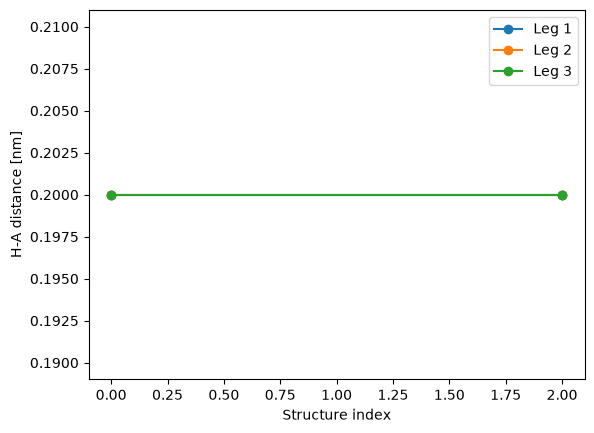
All three legs must exist in the same frame. The empty middle frame has both terminal legs but lacks the connecting leg. Nine singleton roles preserve both mediator oxygens wherever they recur; only hydrogens actually used are participants. Alternative middle-leg hydrogens identify separate paths. Internal and between scopes require the mediator atoms just as they do for order one. Periodic imaging joins the first two legs at one oxygen, then the third at the other, preserving all observed relative geometries.
for branch in range(1, 4):
    plt.plot(two_waters.occurrence_structures,
             two_waters.measurements[f'leg_{branch}_hydrogen_acceptor_distance'],
             'o-', label=f'Leg {branch}')
plt.xlabel('Structure index'); plt.ylabel('H-A distance [nm]'); plt.legend(); plt.show()
print('Exact order:', two_waters.parameters['mediator_order'])
print('Measure columns:', len(two_waters.measurements))
Exact order: 2
Measure columns: 15
See also
Related Tools & References
molsysmt.Interactions.query()— querying observations by actual atom and structure indices.